
- September 26, 2025
- Posted by: feinuojixie
- Category: Chain Guides News

In the fast-paced world of industrial production, conveyor systems are the unsung heroes, acting as the circulatory systems within manufacturing plants, warehouses, and distribution centers. They ensure the seamless movement of products, components, and materials from one stage of the production line to another. Whether it’s the assembly of automobiles, the packaging of consumer goods, or the sorting of parcels in a logistics hub, conveyor systems are fundamental to maintaining the rhythm of operations.
However, these workhorse systems are not without their challenges. One of the most persistent issues is wear and tear. Components such as rollers, belts, and guide rails are constantly under stress, rubbing against products and each other as they facilitate movement. Over time, this friction leads to significant wear, which not only reduces the lifespan of these components but also increases the frequency of maintenance and replacement. For example, in a high – volume food processing plant where conveyors run continuously for hours, the constant movement of packaged goods can quickly wear down the guide rails, leading to misalignment of products and potential production slowdowns.
Inefficiency is another major headache. Inadequate conveyor system design or worn – out components can result in jams, product spills, and inconsistent product flow. This inefficiency translates into lost productivity, increased labor costs for troubleshooting, and potential damage to products. In a busy e – commerce fulfillment center, a single conveyor jam can delay the shipment of hundreds of orders, leading to customer dissatisfaction and costly shipping delays.
Enter the UHMW guide rails, a game – changing solution that addresses these long – standing issues head – on. With their unique properties and design, they offer a glimmer of hope for industries struggling to balance productivity, cost – effectiveness, and equipment longevity.

What are UHMW Guide Rails
Material Composition and Properties
UHMW guide rails are made from Ultra – High – Molecular – Weight Polyethylene. This material is a marvel of modern polymer science, with a molecular weight typically in the range of 3.5 to 9.2 million. Such a high molecular weight contributes to its extraordinary properties.
One of the most remarkable properties of UHMW is its exceptional abrasion resistance. It can withstand continuous rubbing and scraping far better than many traditional materials used in guide rails, such as metal or standard plastics. In a manufacturing environment where products are constantly moving along the conveyor, the high abrasion resistance of UHMW ensures that the guide rails do not wear down quickly. For instance, in a metal parts manufacturing plant, the UHMW guide rails can endure the rough handling of heavy metal components being conveyed, maintaining their integrity over a long period.
UHMW also has an extremely low coefficient of friction. This means that objects moving along the UHMW guide rails encounter minimal resistance. Think of it like a super – smooth track; products can glide along with ease. The low friction not only reduces the energy required to move products on the conveyor but also minimizes the heat generated during operation. In a food packaging conveyor, the low – friction UHMW guide rails ensure that delicate food products are not damaged during transportation as there is less force acting against them.
Another advantage is its self – lubricating property. UHMW does not require external lubricants to function smoothly. This is a significant benefit in industries where lubricant contamination is a concern, such as the pharmaceutical and food industries. In a pharmaceutical production line, the self – lubricating UHMW guide rails eliminate the risk of lubricant residues getting onto the drugs, ensuring product purity and safety.
Structure and Design Features
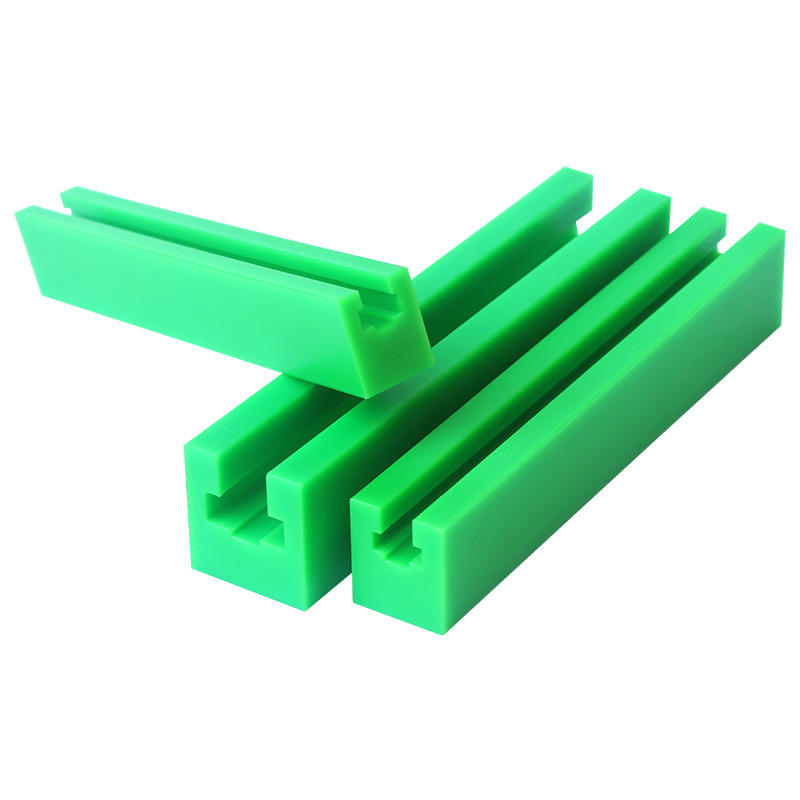
UHMW guide rails come in a variety of designs, but they generally share some common structural features that are optimized for conveyor system use.
Most UHMW guide rails have a smooth, flat surface that provides a stable and even path for products to travel on. This flat surface design minimizes the chances of products getting stuck or misaligned. In a beverage bottling plant, the flat – surface UHMW guide rails ensure that the bottles move in a straight line, facilitating efficient filling and capping processes.
They are often designed with a specific profile to fit seamlessly with the conveyor belts and rollers. This compatibility ensures a tight fit, reducing any gaps where products could potentially get caught. For example, in an automotive parts assembly conveyor, the well – designed UHMW guide rails match the contour of the conveyor components, allowing for the smooth transfer of parts from one station to another.
Some UHMW guide rails also feature edge – protection designs. These edges are rounded or have additional protective layers to prevent damage to the products being conveyed. In an electronics manufacturing conveyor, where delicate circuit boards are being transported, the edge – protected UHMW guide rails prevent the boards from getting scratched or chipped as they move along the conveyor. Additionally, the lightweight nature of UHMW materials, despite their durability, makes the guide rails easy to install and replace, further enhancing the overall efficiency of the conveyor system maintenance process.
UHMW Guide Rails and Wear Reduction
The Wear Problem in Conveyor Systems
Wear is an inevitable but highly problematic aspect of conveyor system operation. In conveyor systems, components such as rollers, idlers, and guide rails are constantly in motion, and this continuous movement exposes them to significant stress. Rollers, for example, bear the weight of products as they rotate, and the constant friction between the rollers and the conveyor belt or the products themselves can cause the roller surfaces to wear out. Over time, the smooth surface of the rollers may become pitted or uneven, which can disrupt the smooth movement of products on the conveyor.
The conveyor belts are also highly susceptible to wear. They are in constant contact with the products being transported, the rollers, and the guide rails. Sharp – edged products can scrape the surface of the belt, while heavy loads can cause the belt to stretch and thin out over time. In a mining operation where conveyor belts are used to transport large amounts of ore, the abrasive nature of the ore can quickly wear down the belt, leading to frequent replacements.
Guide rails, which are crucial for keeping products on the correct path, also face wear issues. As products move along the conveyor, they rub against the guide rails, causing the rails to wear. In a packaging plant, the continuous movement of boxes along the guide rails can cause the edges of the rails to become worn, which may lead to misalignment of the boxes and potential jams in the conveyor system.
The negative impacts of this wear are far – reaching. Firstly, it reduces the lifespan of conveyor components. Worn – out components need to be replaced more frequently, which means higher maintenance costs. In a large – scale manufacturing facility, the cost of replacing conveyor components can amount to thousands of dollars per year. Secondly, it can lead to production slowdowns or stoppages. If a conveyor belt fails due to excessive wear, the entire production line may have to be halted until the belt is replaced. This not only reduces productivity but also incurs additional costs for labor and potential loss of business if orders cannot be fulfilled on time.
How UHMW Guide Rails Combat Wear
UHMW guide rails offer a highly effective solution to the wear problem in conveyor systems, thanks to their unique material properties and design features.
The material properties of UHMW play a crucial role in reducing wear. As mentioned earlier, UHMW has exceptional abrasion resistance. Its high – molecular – weight structure makes it extremely durable, allowing it to withstand the continuous friction and scraping that occurs in conveyor systems. In comparison to traditional metal guide rails, UHMW guide rails can last significantly longer. Metal guide rails are prone to rust and corrosion in addition to wear from friction. In a food processing plant where there is a high humidity environment, metal guide rails may rust over time, which not only reduces their lifespan but also poses a risk of contamination to the food products. UHMW guide rails, on the other hand, are resistant to moisture and do not rust, maintaining their integrity and performance over a long period.
The low coefficient of friction of UHMW is another key factor in reducing wear. When products move along UHMW guide rails, the minimal resistance means that there is less force acting on the guide rails and the products. This reduces the amount of wear and tear on both the guide rails and the products being conveyed. In an electronics manufacturing conveyor, where delicate circuit boards are being transported, the low – friction UHMW guide rails prevent the boards from getting scratched or damaged as they move along, while also minimizing the wear on the guide rails themselves.
The self – lubricating property of UHMW further contributes to wear reduction. Without the need for external lubricants, there is no risk of lubricant – related wear issues. In some traditional conveyor systems, lubricants can attract dust and debris, which can then cause abrasive wear. In a dusty industrial environment, if lubricated guide rails attract dust, the dust – lubricant mixture can act like sandpaper, accelerating the wear of the guide rails. UHMW guide rails eliminate this problem, ensuring a cleaner and more efficient operation with reduced wear.
The design features of UHMW guide rails also enhance their wear – reduction capabilities. Their smooth, flat surface provides a consistent and stable path for products, reducing the chances of products jolting or rubbing against the guide rails in an uneven manner. This even contact distribution minimizes the concentration of wear on specific areas of the guide rails. For example, in a beverage canning plant, the smooth – surface UHMW guide rails ensure that the cans move smoothly, preventing any unnecessary impacts that could cause wear on the guide rails.
The compatibility of UHMW guide rails with conveyor belts and rollers also helps in reducing wear. A well – designed fit ensures that the forces are evenly distributed, preventing excessive stress on any one component. In a logistics conveyor where large packages are being moved, the proper fit of UHMW guide rails with the conveyor system components ensures that the weight of the packages is evenly supported, reducing the wear on the guide rails and the conveyor belt.
There are numerous real – world examples that demonstrate the wear – reduction effectiveness of UHMW guide rails. In a large – scale automotive parts manufacturing plant, the company replaced its old metal guide rails with UHMW guide rails. Before the replacement, the metal guide rails needed to be replaced every six months due to excessive wear. After installing the UHMW guide rails, the replacement interval was extended to two years. This not only saved the company a significant amount of money in replacement costs but also reduced the downtime associated with replacing the guide rails, leading to increased productivity.
In a food packaging facility, the use of UHMW guide rails reduced the damage to food packages caused by friction. The smooth – running UHMW guide rails ensured that the packages moved without getting scratched or torn, while also reducing the wear on the guide rails themselves. This improved the overall quality of the packaged products and reduced the waste associated with damaged packages.

Boosting Conveyor Efficiency with UHMW Guide Rails
Efficiency Enhancement Mechanisms
UHMW guide rails enhance conveyor efficiency through multiple mechanisms. Their low coefficient of friction is a major contributor. When products move along the conveyor, the reduced friction means that less energy is required to keep them in motion. In a large – scale distribution center with long – distance conveyor runs, this energy savings can be significant. For example, a conveyor system that uses traditional guide rails may require a more powerful motor to move heavy packages, while the same system with UHMW guide rails can operate with a smaller, more energy – efficient motor due to the reduced resistance.
The smooth movement facilitated by UHMW guide rails also improves the stability of product flow. Products are less likely to jolt or veer off – course, which is crucial for maintaining a consistent production rate. In a precision manufacturing conveyor for delicate components, such as in a watch – making factory, the stable movement provided by UHMW guide rails ensures that the small parts are transported accurately, reducing the risk of misalignment and subsequent production errors.
Another important aspect is the reduction in maintenance – related downtime. Since UHMW guide rails have excellent wear – resistance and self – lubricating properties, they require less frequent maintenance compared to traditional guide rails. In a continuous – operation food processing plant where the conveyor system runs for 24 hours a day, 7 days a week, the reduced need for maintenance means that the production line can operate for longer periods without interruption. This not only increases the overall productivity of the plant but also reduces the labor and material costs associated with maintenance.
Real – World Efficiency Improvements
Numerous real – world cases demonstrate the remarkable efficiency improvements brought about by UHMW guide rails. In an e – commerce fulfillment center that processes thousands of orders daily, the installation of UHMW guide rails on their conveyor systems led to a 20% increase in the number of packages processed per hour. Before the upgrade, the conveyor system often experienced jams due to the high – friction guide rails, which caused delays in order processing. After switching to UHMW guide rails, the smooth movement of packages reduced the number of jams significantly, allowing the workers to handle more packages within the same time frame.
A large – scale automotive assembly plant also saw substantial benefits. By replacing their old metal guide rails with UHMW guide rails, they were able to reduce the cycle time of their conveyor – based assembly line by 15%. The low – friction UHMW guide rails enabled the components to move more quickly between workstations, while the improved wear – resistance meant that the guide rails did not need to be replaced as often. This led to a significant increase in the plant’s production capacity, allowing them to meet the growing demand for their vehicles more effectively.
In a packaging plant that deals with high – volume production of consumer goods, the use of UHMW guide rails improved the overall conveyor system efficiency by 30%. The self – lubricating property of UHMW eliminated the need for regular lubrication of the guide rails, which used to be a time – consuming task. Additionally, the reduced wear on the conveyor belts and products due to the low – friction UHMW guide rails led to cost savings in terms of replacement parts and product waste. These real – world examples clearly illustrate the tangible benefits of UHMW guide rails in enhancing conveyor efficiency across different industries.
Cost – effectiveness of UHMW Guide Rails
Initial Investment vs. Long – term Savings
When considering the adoption of UHMW guide rails in a conveyor system, one of the first aspects that businesses look at is the initial investment. It’s true that the upfront cost of UHMW guide rails may be higher compared to some traditional guide rail materials, such as basic plastics or certain types of metal alloys. For example, in a small – scale manufacturing unit, the purchase price of UHMW guide rails for a medium – sized conveyor system might be 20 – 30% more expensive than traditional metal guide rails. This price difference can be a deterrent for some companies, especially those with tight budgets or a short – term focus.
However, when we shift our perspective to the long – term, the cost – savings offered by UHMW guide rails become apparent. Due to their exceptional wear – resistance, UHMW guide rails have a significantly longer lifespan. As mentioned earlier, in an automotive parts manufacturing plant, the replacement interval for metal guide rails was six months, while UHMW guide rails could last up to two years. This reduced frequency of replacement means substantial savings over time. The cost of purchasing and installing replacement guide rails, including labor costs, can be a major expense. By extending the replacement cycle, companies can save thousands of dollars annually in a large – scale operation.
Moreover, the energy savings associated with UHMW guide rails also contribute to long – term cost – savings. Their low coefficient of friction reduces the energy required to move products along the conveyor. In a large distribution center with multiple conveyor lines running continuously, these energy savings can translate into significant cost reductions on the electricity bill over the years. For instance, if a conveyor system consumes 1000 kilowatt – hours of electricity per day with traditional guide rails, the use of UHMW guide rails might reduce this consumption by 10 – 15%, resulting in noticeable savings in the long run.
Total Cost of Ownership Analysis
A comprehensive total cost of ownership (TCO) analysis further highlights the cost – effectiveness of UHMW guide rails. TCO takes into account not only the initial purchase price but also all the costs associated with owning and operating the guide rails over their entire lifespan.
Maintenance cost is a significant component of TCO. UHMW guide rails have minimal maintenance requirements. Their self – lubricating property eliminates the need for regular lubrication, which is both time – consuming and costly in traditional conveyor systems. In a food processing plant, the regular lubrication of metal guide rails might require the services of a maintenance worker for a few hours every week, along with the cost of purchasing lubricants. With UHMW guide rails, this maintenance task is eliminated, saving both labor and material costs.
The replacement frequency, as already discussed, has a major impact on TCO. Frequent replacements due to wear not only incur the cost of new guide rails but also the cost of production downtime. When a conveyor system is shut down for guide rail replacement, it can lead to a loss of productivity. In a high – volume production facility, the cost of production loss during a single shutdown for guide rail replacement can be in the thousands of dollars. UHMW guide rails, with their long lifespan, minimize these costly production disruptions.
Another factor to consider is the potential damage to products during transportation. Traditional guide rails with higher friction and wear – related issues may cause more damage to products being conveyed. In an electronics manufacturing plant, if delicate circuit boards are scratched or damaged due to the rough movement on worn – out guide rails, the cost of these damaged products can add up significantly. UHMW guide rails, with their smooth operation and low – friction surface, reduce the likelihood of product damage, thereby saving on the cost of product replacement or rework. Overall, when all these factors are considered in a total cost of ownership analysis, UHMW guide rails prove to be a cost – effective solution for conveyor systems in the long – term.
Comparison with Other Guide Rail Materials
Performance Comparison
When comparing UHMW guide rails with traditional guide rail materials such as metal and common plastics, significant differences in performance become evident.
Metal guide rails, like steel, are known for their high strength and rigidity. They can support heavy loads without deforming easily. However, in terms of wear resistance, they pale in comparison to UHMW guide rails. Metal is prone to corrosion in certain environments, such as those with high humidity or exposure to chemicals. In a coastal factory where the air contains salt particles, metal guide rails may start to rust within a relatively short period. Rust not only weakens the structure of the metal but also increases the friction between the guide rails and the products being conveyed, leading to faster wear and potential damage to the products.
The coefficient of friction of metal guide rails is also relatively high. This means that more energy is required to move products along them. In a conveyor system with long – distance runs, the energy consumption due to the high – friction metal guide rails can be substantial. Additionally, metal guide rails do not have self – lubricating properties, so they require regular lubrication. This lubrication process can be time – consuming and costly, and if not done properly, it can lead to lubricant – related issues such as attracting dust and debris, which further accelerates wear.
Common plastics, on the other hand, are often lightweight and inexpensive. But they lack the durability and wear – resistance of UHMW. Many common plastics have a relatively low melting point, which can be a problem in conveyor systems that operate in high – temperature environments. In a food processing plant where hot – filled products are being conveyed, common plastic guide rails may soften or even melt under the heat, rendering them useless. Their coefficient of friction may also be higher than that of UHMW, leading to less – efficient product movement and potentially more wear on the conveyor components.
UHMW guide rails, with their exceptional abrasion resistance, low coefficient of friction, and self – lubricating properties, outperform both metal and common plastics in many aspects. They can withstand continuous use in harsh environments without significant wear, ensuring a long service life. Their low – friction surface allows for smooth product movement, reducing energy consumption and minimizing product damage. And their self – lubricating nature eliminates the need for external lubricants, making them more convenient and cost – effective to operate.
Cost and Application Suitability Comparison
Cost is an important factor when choosing guide rail materials, and UHMW guide rails offer a unique balance. As mentioned before, the initial cost of UHMW guide rails may be higher than that of some common plastics or lower – grade metals. However, when considering the total cost of ownership, UHMW guide rails prove to be more cost – effective in the long run. Their long lifespan reduces the frequency of replacement, saving on both the cost of new guide rails and the labor cost associated with replacement. The energy savings due to their low coefficient of friction also contribute to long – term cost – reduction.
In terms of application suitability, metal guide rails are suitable for applications that require extremely high strength and load – bearing capacity, such as in heavy – duty industrial conveyors for large machinery parts. But their limitations in wear resistance and the need for regular maintenance make them less ideal for applications where continuous operation and low – maintenance are crucial.
Common plastics are often used in low – cost, low – performance applications where the requirements for durability and wear – resistance are not very high. For example, in some simple, short – term use conveyor systems in small – scale workshops, common plastics may be a cost – effective choice.
UHMW guide rails, on the other hand, are highly suitable for a wide range of applications. In the food and beverage industry, their self – lubricating and non – contaminating properties make them ideal for conveying food products. In the electronics industry, their ability to protect delicate components from damage during transportation, thanks to their low – friction surface, is highly valued. In logistics and distribution centers, their long lifespan and low – maintenance requirements ensure efficient operation in high – volume, continuous – use conveyor systems. Overall, UHMW guide rails offer a combination of performance and cost – effectiveness that makes them a preferred choice in many industrial applications.
Choosing the Right UHMW Guide Rails
Key Selection Factors
When it comes to choosing the right UHMW guide rails for a conveyor system, several key factors need to be taken into account.
The type of conveyor system is a fundamental consideration. Different conveyor types, such as belt conveyors, roller conveyors, or chain conveyors, have varying requirements for guide rails. For example, in a belt conveyor system, the guide rails need to be designed to support the belt and ensure that it runs smoothly without sagging or deviating from its path. In a roller conveyor, the guide rails should be compatible with the rollers, allowing for easy movement of products while also providing proper alignment. In a food packaging belt conveyor, the UHMW guide rails need to be designed in a way that they can support the lightweight food packages and keep the conveyor belt running straight.
The working environment also plays a crucial role. If the conveyor system operates in a high – humidity environment, such as in a car wash or a seafood processing plant, the UHMW guide rails should be resistant to moisture and corrosion. In a dusty industrial setting, like a cement factory, the guide rails should be able to withstand the abrasive effects of dust particles without getting damaged. In a pharmaceutical production area, where cleanliness is of utmost importance, the guide rails need to be easy to clean and should not accumulate dust or contaminants.
The load capacity is another significant factor. The UHMW guide rails must be able to support the weight of the products being conveyed without deforming or breaking. In a heavy – duty manufacturing plant that transports large metal components, the guide rails need to have a high load – bearing capacity. For instance, if the conveyor is used to move engine blocks in an automotive factory, the UHMW guide rails should be designed to handle the substantial weight of these components.
The speed of the conveyor is also relevant. In high – speed conveyor systems, such as those in a high – volume bottling plant, the guide rails need to be able to maintain their integrity and performance even when products are moving at a fast pace. The smoothness of the guide rails becomes even more critical at high speeds to prevent jams and ensure the continuous flow of products.
Supplier and Product Evaluation
Evaluating suppliers and products is essential to ensure that you get high – quality UHMW guide rails.
First, research the reputation of the suppliers. Look for suppliers with a long – standing presence in the industry and positive customer reviews. A supplier with a good reputation is more likely to provide reliable products and excellent customer service. You can check online reviews, industry forums, and ask for references from other companies that have used their products. For example, if a particular UHMW guide rail supplier has been in business for over 20 years and has consistently received positive feedback from its customers in terms of product quality and delivery times, it is a good sign of their reliability.
Examine the product specifications provided by the supplier. The specifications should include details about the material properties of the UHMW guide rails, such as the molecular weight of the polyethylene, the coefficient of friction, and the abrasion resistance rating. A higher molecular weight generally indicates better durability and performance. Compare the specifications of different suppliers to find the best – fitting product for your needs. If Supplier A offers UHMW guide rails with a molecular weight of 6 million and a coefficient of friction of 0.05, while Supplier B offers guide rails with a molecular weight of 4 million and a coefficient of friction of 0.08, Supplier A’s product may be more suitable for applications where low – friction and high – durability are crucial.
Request samples from the suppliers. By physically examining the samples, you can assess the quality of the UHMW guide rails. Check for any visible defects, such as cracks, uneven surfaces, or poor finishing. You can also perform simple tests on the samples, such as measuring the thickness and checking the flexibility. In a laboratory – like setting, you can conduct basic wear – resistance tests on the samples to get an idea of how they will perform in real – world applications.
Consider the supplier’s after – sales service. A good supplier will offer technical support, warranty options, and prompt response to any issues that may arise. If you encounter problems with the UHMW guide rails after installation, the supplier should be willing to help troubleshoot and provide solutions. For example, if a guide rail starts to show signs of excessive wear earlier than expected, the supplier should be able to offer advice on whether it is a problem with the installation, the operating conditions, or a defect in the product itself. Additionally, a long – term warranty can provide peace of mind, knowing that you are protected against potential product failures.
Maintenance and Care of UHMW Guide Rails
Routine Maintenance Practices
Proper maintenance of UHMW guide rails is essential to ensure their long – term performance and the continued efficiency of the conveyor system. Regular cleaning is the first step in maintenance. Over time, dust, debris, and small particles can accumulate on the surface of the UHMW guide rails. In a manufacturing environment where metal shavings are produced, these shavings can get trapped on the guide rails. Using a clean, dry cloth or a soft – bristle brush, gently wipe the surface of the guide rails to remove any dirt. In some cases, if the debris is stubborn, a mild detergent mixed with water can be used, but it’s crucial to ensure that the guide rails are thoroughly dried afterward to prevent any moisture – related damage.
Regular inspection is another vital aspect of routine maintenance. Check the guide rails for any signs of wear, such as scratches, dents, or uneven surfaces. Look for any signs of misalignment, which could indicate a problem with the conveyor system’s components. In a conveyor system that has been in operation for a while, the fasteners holding the guide rails in place may loosen. Regularly check these fasteners and tighten them if necessary. In a large – scale logistics conveyor, where heavy packages are constantly moving, the vibrations can cause the fasteners to become loose over time.
Lubrication, although UHMW guide rails are self – lubricating, may still require occasional attention in some high – stress applications. In conveyor systems that operate in extremely dusty or abrasive environments, a light – duty, non – contaminating lubricant can be applied sparingly to further reduce friction and wear. However, it’s important to use a lubricant that is compatible with the UHMW material and does not compromise its properties. For example, in a mining conveyor system where the UHMW guide rails are exposed to large amounts of dust and abrasive particles, a food – grade lubricant may be used to ensure that there is no contamination in case of any product spillage.
Troubleshooting and Problem – Solving
Despite their durability and low – maintenance nature, UHMW guide rails may encounter some problems over time. One common issue is excessive wear in certain areas. If this occurs, it could be due to misalignment of the conveyor components, which causes uneven stress on the guide rails. To solve this, first, check the alignment of the conveyor belts, rollers, and other related components. Adjust them as necessary to ensure that the products move evenly along the guide rails. In a packaging conveyor, if the belt is not aligned properly, the packages may constantly rub against one side of the guide rail, leading to excessive wear.
Another problem could be the presence of noise during operation. Unusual noises can indicate a variety of issues, such as a foreign object stuck between the guide rail and the product or a mechanical problem with the conveyor system. Stop the conveyor immediately and carefully inspect the guide rails and the surrounding area for any foreign objects. If no object is found, check the conveyor’s mechanical components, such as the bearings of the rollers, as a faulty bearing can also cause noise. In a beverage bottling conveyor, a small piece of broken glass stuck between the guide rail and a bottle can create a rattling noise.
If the UHMW guide rails show signs of deformation, it may be due to overloading of the conveyor system. Review the load capacity of the guide rails and the actual weight of the products being conveyed. If the load is too heavy, consider redistributing the products or upgrading to guide rails with a higher load – bearing capacity. In a construction materials conveyor where large, heavy bricks are being transported, overloading can cause the UHMW guide rails to bend or warp. By being aware of these common problems and their solutions, businesses can quickly address any issues that arise with their UHMW guide rails, minimizing downtime and ensuring the continued efficient operation of their conveyor systems.
Future Trends and Developments
Technological Advancements in UHMW Materials
The future of UHMW materials holds great promise, with ongoing research and development aiming to further enhance their already impressive properties. Scientists and material engineers are constantly exploring ways to improve the performance of UHMW. One area of focus is on increasing its strength – to – weight ratio. By fine – tuning the molecular structure of UHMW, researchers hope to create a material that can withstand even heavier loads while maintaining its lightweight nature. This could open up new possibilities for its use in industries where weight reduction is crucial, such as aerospace and automotive manufacturing. For example, in the aerospace industry, the use of stronger and lighter UHMW components could lead to more fuel – efficient aircraft, reducing operating costs and environmental impact.
Another aspect of technological advancement is in the development of UHMW materials with enhanced chemical resistance. As industries become more diverse and demanding, the need for materials that can resist a wider range of chemicals becomes increasingly important. In the chemical processing industry, UHMW guide rails with improved chemical resistance could be used to convey corrosive substances without being damaged, ensuring the smooth operation of the production line and reducing the need for frequent replacements.
The integration of nanotechnology with UHMW materials is also an emerging trend. Nanoparticles can be added to UHMW matrices to create nanocomposites with unique properties. These nanocomposites may have improved mechanical properties, such as higher stiffness and toughness, as well as enhanced thermal and electrical conductivity. In conveyor systems, UHMW – based nanocomposite guide rails could offer better performance in high – temperature or electrically charged environments. For instance, in an electronics manufacturing plant where there are electrostatic discharge risks, the use of UHMW nanocomposite guide rails with anti – static properties could prevent damage to sensitive electronic components.
Potential New Applications in Conveyor Systems
As UHMW guide rails continue to prove their worth in traditional conveyor system applications, new and exciting opportunities are emerging. One potential new application is in the field of automated storage and retrieval systems (AS/RS). These systems are becoming increasingly popular in large – scale warehouses and distribution centers due to their high – efficiency and space – saving capabilities. UHMW guide rails could play a crucial role in AS/RS by guiding the movement of automated vehicles or shuttles. Their low – friction and wear – resistant properties would ensure smooth and reliable operation, reducing the risk of mechanical failures and improving the overall throughput of the system. In a large e – commerce warehouse with thousands of storage bins, the use of UHMW guide rails in the AS/RS could significantly speed up the process of retrieving and storing products, leading to faster order fulfillment.
The development of high – speed conveyor systems for the transportation of high – value goods is another area where UHMW guide rails could find new applications. In the luxury goods industry, for example, where items such as high – end watches, jewelry, and designer handbags need to be transported quickly and safely, UHMW guide rails can provide the necessary smoothness and stability. Their ability to minimize vibrations and ensure precise product movement is essential for preventing damage to these valuable items. In a luxury watch manufacturing facility, high – speed conveyor systems with UHMW guide rails could be used to quickly move the delicate watch components between different production stages, increasing productivity without compromising on quality.
With the growing trend towards sustainable and green manufacturing, UHMW guide rails may also be used in conveyor systems for recycling plants. These plants deal with a wide variety of materials, including plastics, metals, and paper, which can be abrasive and difficult to handle. UHMW guide rails’ wear – resistance and durability make them suitable for use in recycling conveyor systems, where they can help to improve the efficiency of the recycling process. For example, in a plastic recycling plant, UHMW guide rails can guide the movement of plastic waste through the sorting and processing stages, ensuring that the materials are handled properly and reducing the risk of jams or breakdowns in the conveyor system. This, in turn, contributes to a more sustainable and efficient recycling operation.

Conclusion
Recap of the Benefits of UHMW Guide Rails
In summary, UHMW guide rails offer a plethora of benefits that can significantly transform conveyor system operations. Their outstanding wear – reduction capabilities, stemming from high abrasion resistance, low coefficient of friction, and self – lubricating properties, ensure that conveyor components last longer. This not only reduces the frequency of costly replacements but also minimizes the risk of production disruptions due to component failures.
The efficiency – boosting features of UHMW guide rails are equally remarkable. By reducing friction, they enable products to move smoothly, which in turn cuts down on energy consumption. The stable product flow they provide leads to increased productivity, as there are fewer jams and misalignments. This enhanced efficiency can have a cascading effect on the entire production process, allowing businesses to meet higher demands and improve their competitiveness.
From a cost – effectiveness perspective, although the initial investment in UHMW guide rails may be relatively high, the long – term savings in terms of maintenance, energy, and replacement costs far outweigh this. Their long lifespan and low maintenance requirements contribute to a lower total cost of ownership, making them a wise investment for any company relying on conveyor systems.
Encouragement for Adoption in Conveyor Systems
For industries that rely on conveyor systems, the advantages of UHMW guide rails are too significant to ignore. Whether it’s a manufacturing plant aiming to increase production output, a warehouse striving to optimize its logistics, or a distribution center looking to enhance order – fulfillment speed, UHMW guide rails can be the key to achieving these goals. By making the switch to UHMW guide rails, companies can experience improved conveyor system performance, reduced operational costs, and a more reliable production process. As the technology behind UHMW materials continues to advance and new applications are explored, the potential benefits of UHMW guide rails in conveyor systems are only set to grow. So, don’t let wear and inefficiency hold your operations back. Consider adopting UHMW guide rails and unlock the full potential of your conveyor systems.