
- September 30, 2025
- Posted by: feinuojixie
- Category: Chain Guides News

In the world of industrial equipment, guide wear strips are unassuming yet crucial components. They can be found in a wide range of machinery, from conveyor systems that transport goods in warehouses to manufacturing equipment that produces precision parts. These seemingly simple strips play a vital role in ensuring smooth operation, reducing friction, and providing stability. But did you know that investing in a quality guide wear strip can be a game – changer when it comes to saving both time and money? This might seem hard to believe at first glance, but as we dig deeper into the functions and benefits of high – quality guide wear strips, you’ll discover how this small component can have a significant impact on your bottom line.
Understanding the Guide Wear Strip
What is a Guide Wear Strip?
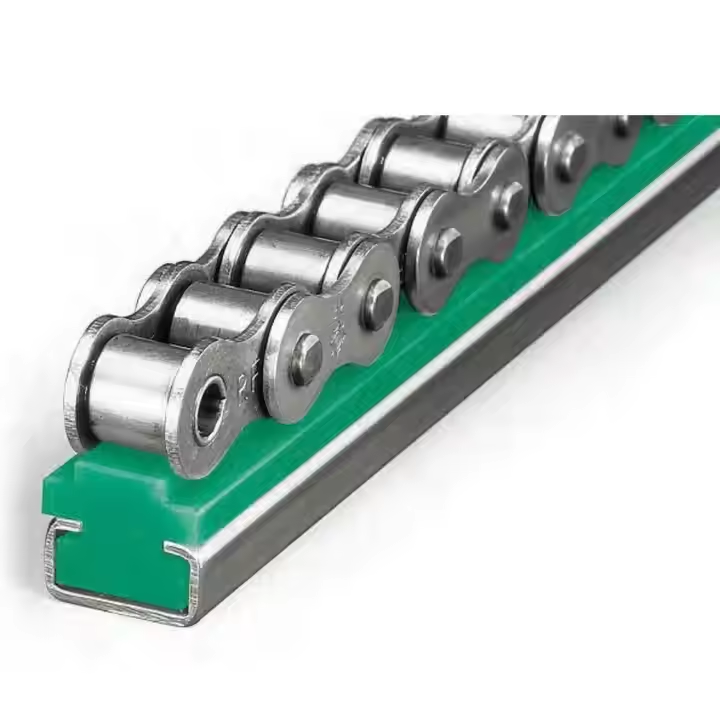
A guide wear strip, also known as a guide rail strip or slide wear strip, is a linear component typically made from materials like high – density polyethylene (HDPE), ultra – high – molecular – weight polyethylene (UHMW – PE), or some types of engineered plastics and metals. Structurally, it is usually a long, flat strip with a smooth surface. In many cases, it may have grooves or holes for easy installation. For example, in a simple linear slide system, the guide wear strip is often mounted on the stationary part of the equipment, such as the base of a linear actuator.
Here is a simple diagram to illustrate its position:
[Draw a basic linear slide system with a moving carriage and a stationary base. Mark the guide wear strip on the base, with the moving part (carriage) gliding along it.]
Key Functions in Machinery
- Guiding Function: One of the primary functions of a guide wear strip is to guide the movement of components in machinery. In a conveyor system, for instance, the guide wear strips are installed along the sides of the conveyor belt. They ensure that the items being transported move in a straight and controlled path. Without these strips, the products could veer off – course, leading to jams or misalignment issues.
- Supporting Function: Guide wear strips also offer support to moving parts. In a machine tool, the slide – way on which the cutting tool moves is often equipped with guide wear strips. These strips support the weight of the cutting tool and the forces exerted during the cutting process. This support helps maintain the accuracy of the machining operation. For example, in precision milling machines, the guide wear strips ensure that the cutting tool moves precisely along the intended path, resulting in high – quality finished products.
- Protecting Function: They protect the main components of the machinery from wear and tear. In an automated robotic arm, the joints and moving parts are often fitted with guide wear strips. As the arm moves, the strips bear the brunt of the friction and contact forces. This protection extends the lifespan of the more expensive and critical components of the robotic arm, such as the motors and the mechanical linkages.
Time – Savings Brought by Quality Guide Wear Strips
Reducing Downtime
Downtime in industrial operations can be a costly nightmare. When a guide wear strip is of poor quality, it is more likely to experience premature wear, breakage, or misalignment. For example, in a high – speed packaging machine, a low – quality guide wear strip may start to fray or crack after just a few weeks of operation. As a result, the machine may jam, and the production line has to be halted. This not only stops the current production but also requires time for troubleshooting, repairs, and restarting the equipment.
In contrast, a quality guide wear strip is engineered to withstand heavy use and maintain its integrity over a long period. High – quality materials and precise manufacturing processes ensure that it doesn’t wear out quickly. A case study in a large – scale automotive manufacturing plant showed that by upgrading to quality guide wear strips on their conveyor systems, they were able to reduce their annual downtime from 100 hours to just 20 hours. This significant reduction in downtime meant that the production line could operate more efficiently, producing more cars in the same amount of time.
Faster Maintenance and Replacement
Quality guide wear strips are often designed with user – friendly features that make maintenance and replacement a breeze. For instance, some high – quality guide wear strips come with pre – drilled holes or a snap – fit installation mechanism. In a wood – processing factory, when it was time to replace the guide wear strips on their planing machines, the workers found that the new, high – quality strips they had purchased were much easier to install. The pre – drilled holes on the new strips aligned perfectly with the machine’s mounting points, and the installation process took only half the time it used to take with the previous, lower – quality strips.
Moreover, these quality guide wear strips are more durable, so they don’t need to be replaced as frequently. This means that maintenance personnel can spend less time on replacement tasks and more time on other important aspects of equipment maintenance. In a printing press operation, the use of quality guide wear strips reduced the frequency of replacement from once every three months to once every nine months, saving a significant amount of maintenance time over the course of a year.
Streamlining Production Processes
A well – functioning guide wear strip is essential for streamlining production processes. By ensuring smooth and stable movement of components in machinery, it helps to maintain the overall efficiency of the production line. In an electronics manufacturing facility that produces circuit boards, the guide wear strips on the pick – and – place machines play a crucial role. These machines need to place tiny electronic components onto the circuit boards with extreme precision. A high – quality guide wear strip allows the pick – and – place heads to move smoothly and accurately, reducing the number of mis – placed components.
As a result, the production process becomes more streamlined. There are fewer rejects, and the need for rework is minimized. This not only saves time but also reduces material waste. In this particular electronics factory, the implementation of quality guide wear strips increased the production speed by 15% and reduced the defect rate by 30%, leading to a more efficient and cost – effective production process.
Cost – Savings with Quality Guide Wear Strips
Lower Replacement Costs
When considering the cost – effectiveness of guide wear strips, replacement costs play a significant role. A quality guide wear strip, made from high – grade materials like UHMW – PE, has a much longer lifespan compared to its low – quality counterparts. For example, a low – quality guide wear strip made from ordinary plastic might need to be replaced every three months in a medium – intensity industrial application. If the cost of each replacement strip is 50,andthereare100suchstripsinuseacrossafactory,theannualreplacementcostfortheselow−qualitystripswouldbe50×100×4 (since there are 4 replacement cycles in a year) = $20,000.On the other hand, a high – quality guide wear strip made from advanced materials and with better manufacturing precision can last up to a year or more in the same application. Suppose the cost of a high – quality strip is 100×100 = $10,000. Over a long – term period, these savings can add up significantly, making the initial higher investment in quality guide wear strips a much more cost – efficient choice.
Energy Efficiency
Guide wear strips contribute to energy efficiency in industrial machinery. During the operation of machinery, components in contact with each other generate friction. A well – designed and high – quality guide wear strip reduces this friction. For instance, in a large – scale conveyor system that moves heavy loads, the moving parts glide along the guide wear strips. When the strips are of low quality, the increased friction requires more energy to move the conveyor belt.
Studies have shown that high – quality guide wear strips can reduce friction by up to 30% compared to low – quality ones. In a manufacturing plant where the conveyor system consumes 10,000 kilowatt – hours (kWh) of electricity per month, with the use of quality guide wear strips, the energy consumption can be reduced to 7,000 kWh per month. If the cost of electricity is 0.1 = 300.Overayear,thisamountsto300×12 = $3,600 in energy savings. This not only benefits the environment but also the company’s bottom line.
Avoiding Costly Repairs
A malfunctioning or worn – out guide wear strip can lead to more serious and costly problems in industrial equipment. In a metal – cutting machine, for example, if the guide wear strip wears out unevenly, it can cause misalignment of the cutting tool. This misalignment can then lead to excessive stress on the tool, the spindle, and other components of the machine. The cutting tool may break prematurely, and the spindle bearings may become damaged due to the uneven forces.
The cost of replacing a broken cutting tool can range from 100to1000, depending on its type and quality. Repairing or replacing damaged spindle bearings can cost even more, potentially several thousand dollars. In contrast, regularly maintaining and using quality guide wear strips can prevent these issues. By ensuring smooth and accurate movement of components, quality guide wear strips act as a safeguard for the more expensive parts of the machinery. The cost of a quality guide wear strip replacement is often a fraction of the cost of repairing the damage it can prevent, making it a wise investment to avoid costly equipment breakdowns and repairs.
Choosing the Right Quality Guide Wear Strip
Key Quality Indicators
- Material Quality: High – quality materials are the foundation of a good guide wear strip. For example, UHMW – PE is a popular choice due to its excellent wear – resistance, low friction coefficient, and high impact strength. Compared to ordinary plastics, UHMW – PE can withstand more stress and wear during long – term operation. Metal – based guide wear strips, such as those made from aluminum alloy or stainless steel, offer high strength and rigidity, which are suitable for heavy – duty applications.
- Precision: Precision in manufacturing is crucial. A well – made guide wear strip should have tight tolerances. The thickness of the strip, for instance, should be consistent along its length. In a precision – engineered linear motion system, a deviation in the thickness of the guide wear strip by even a fraction of a millimeter can cause uneven wear and affect the accuracy of the moving components.
- Wear Resistance: This is a key indicator of a guide wear strip’s quality. A quality strip should be able to resist wear over an extended period. Laboratory tests can measure the wear rate of a guide wear strip by subjecting it to a specific number of cycles of sliding motion under a certain load. For example, a high – quality guide wear strip might show only a 1 – 2% reduction in thickness after 100,000 cycles of operation, while a low – quality one could experience a 10 – 15% reduction under the same conditions.
Considerations for Different Applications
- Industry – Specific Requirements: Different industries have unique needs. In the food and beverage industry, for example, guide wear strips must be made from food – grade materials that are non – toxic and compliant with strict hygiene standards. UHMW – PE that is certified as food – grade is often used in conveyor systems that transport food products. In the automotive industry, where components are exposed to high temperatures and mechanical stress, heat – resistant and high – strength guide wear strips are required.
- Equipment – Related Considerations: The type of equipment also influences the choice of guide wear strip. In high – speed machinery, such as high – speed printers or automated assembly lines, guide wear strips need to have a very low friction coefficient to ensure smooth and fast movement. In contrast, in heavy – load equipment like construction machinery, the guide wear strip must be able to support a large amount of weight and withstand significant impact forces. For a large – scale hydraulic press, a metal – reinforced guide wear strip might be the best choice to handle the heavy loads and vibrations during operation.
Reputable Brands and Suppliers
- Well – Known Brands: Some well – known brands in the guide wear strip market include Igus, McMaster – Carr, and Trelleborg. Igus is renowned for its high – quality plastic – based guide wear strips, especially those made from its proprietary iglide materials. These strips are known for their durability, low – friction properties, and wide range of applications. McMaster – Carr offers a comprehensive selection of guide wear strips, including both plastic and metal options, with a reputation for fast delivery and high – quality products. Trelleborg is recognized for its engineered polymer solutions, and their guide wear strips are often used in demanding industrial applications.
- Tips for Choosing Suppliers: When choosing a supplier, it’s important to consider their experience in the industry. A supplier with many years of experience is more likely to have a deep understanding of the product and can provide better technical support. Customer reviews and testimonials are also valuable sources of information. Checking online platforms or industry – specific forums can give you an idea of other customers’ experiences with a particular supplier. Additionally, a good supplier should offer a variety of products to meet different needs and be able to provide samples for testing before making a large – scale purchase.
Customer Testimonials
John, the maintenance manager at a food – processing factory, shared his experience: “We switched to a quality guide wear strip a year ago, and it has been a game – changer for us. Before, we were constantly dealing with conveyor belt misalignments and breakdowns, which disrupted our production schedule. Now, with the new guide wear strips, our equipment runs smoothly, and the maintenance has become a breeze. We’ve also noticed a significant reduction in our energy bills. I highly recommend investing in quality guide wear strips to any business looking to improve their operational efficiency.”
Sarah, an engineer at an electronics manufacturing firm, said, “The quality guide wear strips we started using have improved the precision of our automated assembly machines. The parts move more smoothly, and we’ve seen a drastic reduction in the number of defective products. This has not only saved us money in terms of rework and waste but has also enhanced our reputation in the market for delivering high – quality products. It’s a small component that has had a huge impact on our bottom line.”
Conclusion
In conclusion, the significance of a quality guide wear strip in both saving time and money cannot be overstated. From reducing downtime and streamlining production processes to lowering replacement costs and avoiding costly equipment repairs, its benefits are far – reaching. Whether you are in manufacturing, logistics, or any industry that relies on machinery with moving parts, the choice of guide wear strip can have a profound impact on your operational efficiency and financial bottom line.
When considering guide wear strips for your equipment, always prioritize quality. Evaluate the key quality indicators, take into account the specific requirements of your application, and choose from reputable brands and suppliers. The real – world examples and testimonials we’ve explored demonstrate that making the switch to a quality guide wear strip is a decision that pays off in the long run.
So, the next time you are maintaining or upgrading your industrial equipment, don’t overlook the humble guide wear strip. Invest in quality, and you’ll be rewarded with smoother – running machinery, increased productivity, and substantial savings. It’s a small component that can make a huge difference in the success of your operations.
Call to Action
Have you had experiences with guide wear strips in your industrial operations? We’d love to hear your stories! Share your insights in the comments section below. Whether it’s a success story of how a quality guide wear strip saved your company time and money or a challenge you faced with low – quality strips, your experiences can provide valuable knowledge for others in the industry.
If you want to learn more about guide wear strips, our website offers a wealth of resources. You can find in – depth product reviews, technical specifications of different types of guide wear strips, and case studies of various industries. For any questions or to consult with our experts about choosing the right guide wear strip for your specific needs, don’t hesitate to reach out to us. You can contact our customer service team via email at [email address] or give us a call at [phone number]. Start making the most of your industrial equipment today with the right guide wear strip!