
- September 29, 2025
- Posted by: feinuojixie
- Category: Chain Guides News

UHMW guide rails, short for Ultra – High Molecular Weight guide rails, are linear guiding components primarily made from Ultra – High Molecular Weight Polyethylene (UHMW – PE). This material is a marvel of modern polymer science, with a molecular weight typically above 1.5 million, which is far higher than that of conventional plastics.
The uniqueness of UHMW – PE lies in its long – chain molecular structure. These long chains are highly entangled, endowing the material with remarkable properties. UHMW guide rails usually consist of a base rail body made of UHMW – PE, which can be in various shapes such as flat, T – shaped, or L – shaped, depending on the application requirements. Some may also have additional features like grooves or holes for better fixation or to accommodate other components in a mechanical system. For example, in a conveyor system, the UHMW guide rail might have a channel – like structure to precisely guide the movement of the conveyed items.
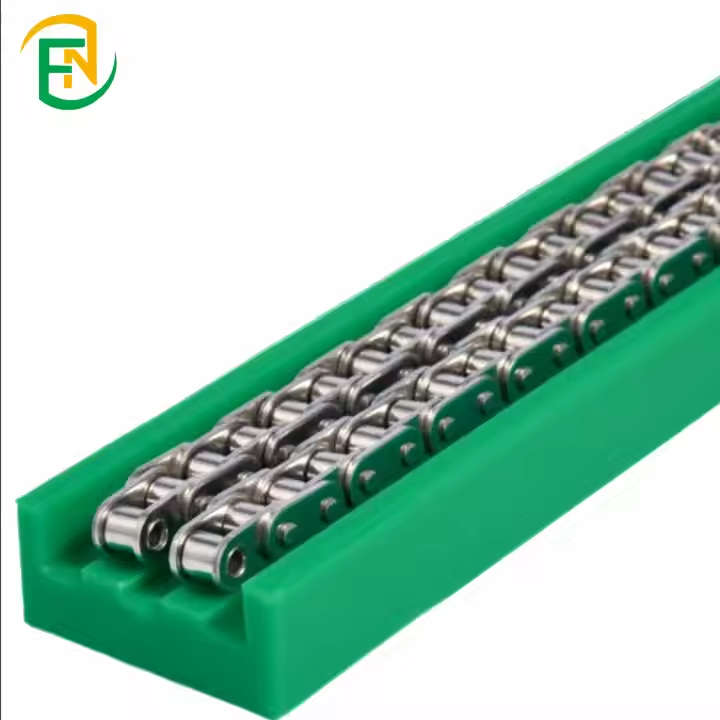
The Inner Workings of UHMW Guide Rails
At the heart of their functionality, UHMW guide rails operate on the principles of low – friction material properties and precise geometric design.
Friction Reduction Mechanisms
The UHMW – PE material has an inherently low coefficient of friction. This means that when a moving part slides along the UHMW guide rail, the frictional forces between the two surfaces are minimized. For instance, compared to metal – on – metal sliding systems, the coefficient of friction of UHMW – PE against many common materials can be up to 10 times lower. This low friction is due to the smooth surface texture of UHMW – PE, which is a result of its long – chain molecular structure. The long chains allow for a more uniform and continuous surface, reducing the microscopic irregularities that would otherwise cause friction. Additionally, UHMW – PE has a self – lubricating property. It doesn’t require external lubricants in many applications, which is a significant advantage as it eliminates the need for lubricant replenishment and reduces the risk of contamination from lubricant leakage. This self – lubrication is a consequence of the material’s molecular characteristics, where the long chains can slide past each other with relative ease, providing a lubricating effect at the interface between the guide rail and the moving component.
Wear Resistance and Durability
UHMW guide rails also exhibit excellent wear resistance. The high molecular weight of UHMW – PE contributes to its durability. When a component moves along the guide rail, the long – chain molecules of UHMW – PE can withstand the repeated mechanical stresses and abrasion. In a high – usage industrial conveyor application where components slide along the guide rails thousands of times a day, UHMW guide rails can maintain their integrity and performance over a long service life. The wear resistance is further enhanced by the material’s resistance to chemical corrosion. UHMW – PE is not easily degraded by common chemicals, so in environments where there may be exposure to mild acids, alkalis, or other corrosive substances, the guide rails can continue to function properly without significant degradation.
Enabling Smooth Linear Motion
The combination of low friction and high wear resistance enables UHMW guide rails to facilitate smooth linear motion. In a precision machinery application, such as a 3D printer’s linear motion system, the UHMW guide rails ensure that the print head can move precisely along the X and Y axes. The smooth motion allows for accurate deposition of materials, resulting in high – quality prints. In a linear slide system used in a manufacturing assembly line, the UHMW guide rails enable components to be moved smoothly and precisely to their intended positions for assembly. This smooth linear motion not only improves the efficiency of the manufacturing process but also reduces the risk of mechanical failures due to sudden stops or jerky movements.
Key Advantages that Set UHMW Guide Rails Apart
Exceptional Wear Resistance
One of the most prominent advantages of UHMW guide rails is their outstanding wear resistance. In industrial settings like mining conveyor systems, where materials are constantly sliding along the guide rails, the high molecular weight of UHMW – PE allows it to endure the intense abrasive forces. For example, in a coal – mining operation, the conveyor belts move large volumes of coal over long distances. UHMW guide rails installed on these conveyors can last significantly longer than traditional metal guide rails. Their long – chain molecular structure makes them highly resistant to the scratches and wear caused by the rough coal particles, reducing the frequency of replacement and maintenance, which in turn cuts down on operational costs.
Low Friction Coefficient
The low coefficient of friction of UHMW guide rails is a game – changer in many applications. In precision machinery such as robotic arms, the smooth movement enabled by the low – friction UHMW guide rails is crucial. When a robotic arm needs to move with high precision to perform tasks like pick – and – place operations in an electronics manufacturing plant, the low – friction UHMW guide rails ensure that the arm can move quickly and accurately. This not only improves the efficiency of the manufacturing process but also reduces the energy consumption required to move the robotic arm. The reduced friction also minimizes the generation of heat during movement, which is beneficial for the long – term performance and lifespan of the mechanical components.
Superior Corrosion Resistance
UHMW guide rails exhibit excellent corrosion resistance, making them suitable for use in harsh environments. In chemical processing plants, where there is constant exposure to various corrosive chemicals, UHMW guide rails can maintain their integrity. For instance, in a plant that produces fertilizers, which often involves handling acidic and alkaline substances, UHMW guide rails can be used in the conveyor systems without being corroded by the chemicals. This is in contrast to metal guide rails, which would quickly succumb to corrosion in such an environment. The corrosion – resistant property of UHMW guide rails extends their service life and reduces the need for frequent replacements, enhancing the overall reliability of the equipment.
Self – Lubricating Properties
The self – lubricating nature of UHMW guide rails is another significant advantage. In food and beverage production lines, where cleanliness is of utmost importance, the self – lubricating property eliminates the need for external lubricants. For example, in a bottling plant, the UHMW guide rails used to guide the movement of bottles can operate smoothly without the risk of lubricant contamination. This ensures that the food and beverage products remain safe and free from any foreign substances. Additionally, in applications where maintenance access is difficult, such as in some aerospace components, the self – lubricating feature of UHMW guide rails means that they can function properly without the need for regular lubrication, reducing the maintenance burden and downtime.

Wide – Ranging Applications of UHMW Guide Rails
UHMW guide rails have found their way into a diverse range of industries, each benefiting from their unique properties in distinct ways.
Industrial Automation
In industrial automation, UHMW guide rails are essential components. In robotic assembly lines, they enable robotic arms to move precisely and smoothly. For example, in an automotive manufacturing plant, where robots are responsible for tasks like welding, painting, and component installation, UHMW guide rails ensure that the robotic arms can reach the exact positions required for these operations. The low – friction and high – wear – resistance properties of UHMW guide rails allow the robots to operate continuously for long hours without significant wear and tear, improving the overall efficiency and productivity of the assembly line. They also contribute to reducing the energy consumption of the robotic systems, as less energy is needed to overcome the frictional forces during movement.
Logistics Equipment
Logistics is another area where UHMW guide rails play a crucial role. In conveyor systems used in warehouses and distribution centers, UHMW guide rails are used to guide the movement of packages and goods. The low – friction surface of the guide rails allows packages to slide easily, reducing the need for excessive power to drive the conveyor belts. This not only saves energy but also minimizes the risk of packages getting stuck or damaged during transportation. In addition, the corrosion – resistance of UHMW guide rails is highly beneficial in logistics environments, as they may be exposed to various substances and environmental conditions. For instance, in a food – distribution warehouse where there may be occasional spills, the UHMW guide rails can withstand the exposure to food residues and cleaning agents without corroding, ensuring the long – term reliability of the conveyor systems.
Medical Equipment
In the medical field, UHMW guide rails are used in a variety of equipment. In X – ray machines and magnetic resonance imaging (MRI) devices, they are used to position the patient – handling components precisely. The smooth linear motion provided by UHMW guide rails is crucial for obtaining accurate medical images. For example, when a patient is being scanned in an MRI machine, the table on which the patient lies needs to move smoothly and precisely to ensure that the images captured are of high quality and can accurately diagnose any medical conditions. The self – lubricating property of UHMW guide rails is also a significant advantage in medical equipment, as it reduces the risk of contamination from external lubricants, which could be harmful to patients. Additionally, in surgical robots, UHMW guide rails enable the precise movement of the robotic surgical tools, allowing surgeons to perform minimally invasive surgeries with greater accuracy and control.
Installation and Maintenance: Ensuring Long – Term Performance
Installation Steps
Installing UHMW guide rails requires precision and attention to detail. First, the installation surface must be thoroughly cleaned and prepared. Any dirt, debris, or unevenness on the surface can affect the performance of the guide rails. For example, in a conveyor system installation, the frame where the UHMW guide rails will be mounted should be sand – blasted to remove rust and painted to prevent future corrosion.
Once the surface is prepared, the guide rails are aligned according to the design specifications. Precise alignment is crucial to ensure smooth linear motion. Special alignment tools such as laser alignment devices can be used to achieve high – precision alignment. After alignment, the guide rails are fixed in place using appropriate fasteners. Depending on the application and the load the guide rails will bear, bolts, screws, or rivets can be used. In a high – load industrial application, high – strength bolts may be required to securely fasten the guide rails to the base structure.
Precautions during Installation
During the installation process, several precautions should be taken. The first is to avoid over – tightening the fasteners. Over – tightening can cause stress concentration in the UHMW guide rails, which may lead to cracking or deformation over time. Torque wrenches should be used to ensure that the fasteners are tightened to the recommended torque values. Additionally, care should be taken not to damage the surface of the UHMW guide rails during installation. Sharp tools or rough handling can scratch the surface, increasing friction and reducing the wear – resistance of the guide rails. Protective coverings can be used during the installation process to prevent surface damage.
Maintenance Recommendations
Regular maintenance is essential to ensure the long – term performance of UHMW guide rails. First and foremost is regular inspection. The guide rails should be visually inspected at regular intervals, such as weekly or monthly depending on the application’s usage intensity. During the inspection, look for signs of wear, such as scratches, grooves, or thinning of the guide rail surface. Also, check for any signs of looseness in the fasteners. If any issues are detected, they should be addressed promptly.
Cleaning the UHMW guide rails is another important maintenance task. Dirt, dust, and debris can accumulate on the guide rails over time, increasing friction and potentially causing damage. A soft brush or a clean, dry cloth can be used to remove loose debris. For more stubborn dirt, a mild detergent solution can be used, followed by thorough rinsing and drying. In a food – processing environment, where cleanliness is critical, the guide rails may need to be cleaned more frequently, perhaps after each production shift.
Lubrication, although less common due to the self – lubricating nature of UHMW – PE, may still be beneficial in some applications. In high – load or high – speed applications, a suitable lubricant can be applied to further reduce friction and wear. However, it’s important to choose a lubricant that is compatible with UHMW – PE and the application environment. For example, in a medical equipment application, the lubricant must be non – toxic and meet strict hygiene standards. Regular lubrication intervals should be established based on the application’s requirements, and the lubricant should be applied evenly along the guide rail surface.
Making the Right Choice: Selecting the Ideal UHMW Guide Rails
Selecting the right UHMW guide rails is crucial for ensuring optimal performance in any application. Here are some key factors to consider:
Load Capacity
The load capacity of UHMW guide rails is a fundamental consideration. Different applications have varying load requirements. In a heavy – duty industrial conveyor system that transports large – volume and high – weight materials, such as in a steel – processing plant where steel coils are being moved, the guide rails need to have a high load – bearing capacity. Calculate the maximum static and dynamic loads that the guide rails will be subjected to. Static load refers to the weight of the objects at rest on the guide rails, while dynamic load accounts for the additional forces generated during movement, such as acceleration and deceleration. Choose UHMW guide rails with a load capacity rating that comfortably exceeds the expected loads to prevent premature wear, deformation, or failure.
Running Speed
The running speed of the components moving along the UHMW guide rails is another important factor. In high – speed automated production lines, like those in the electronics manufacturing industry where components are being assembled at a rapid pace, the guide rails must be able to support smooth movement at high velocities. Some UHMW guide rails are specifically designed to handle high – speed applications. They may have features such as a more uniform surface finish and optimized material properties to reduce friction even at high speeds. If the running speed is high, but the guide rails are not suitable, it can lead to issues like vibration, noise, and reduced accuracy of movement.
Precision Requirements
For applications that demand high precision, such as in optical equipment manufacturing or semiconductor wafer processing, the precision of the UHMW guide rails is of utmost importance. Precision – grade UHMW guide rails are engineered to have tight tolerances in their manufacturing. This ensures that the moving components can be positioned with extreme accuracy. The straightness and flatness of the guide rails play a significant role in achieving high precision. A deviation in these parameters can cause errors in the movement of the components, leading to defective products or inaccurate operations. In a semiconductor lithography machine, for example, the UHMW guide rails need to be extremely precise to ensure that the light patterns are accurately transferred onto the wafers.
Work Environment
The work environment where the UHMW guide rails will be installed also affects the selection process. In a corrosive environment, such as a chemical plant or a marine – based facility, the corrosion – resistance property of UHMW guide rails becomes crucial. In a food – processing plant, where hygiene is a top priority, the self – lubricating and non – contaminating properties of UHMW guide rails are highly desirable. In a high – temperature environment, the heat – resistance of the UHMW – PE material needs to be considered. Some UHMW – PE formulations have better heat – resistance characteristics, which can be suitable for applications where temperatures may rise during operation. Additionally, if the environment is dusty or has a lot of debris, the guide rails should be able to resist the ingress of these particles, which could otherwise increase friction and wear.

Wrapping Up: The Future of UHMW Guide Rails
In summary, UHMW guide rails are more than just simple linear guiding components; they are a testament to the wonders of modern materials science. Their unique properties, including low friction, high wear resistance, corrosion resistance, and self – lubricating capabilities, have made them indispensable in a wide range of industries, from industrial automation to medical equipment.
Looking ahead, the future of UHMW guide rails appears promising. With the continuous advancement of materials science and manufacturing technologies, we can expect to see even more improved UHMW – PE formulations. These could potentially have enhanced properties such as higher temperature resistance, increased load – bearing capacity, and even better precision, which will further expand their application scope. For example, in emerging fields like nanotechnology and quantum computing, where extreme precision and reliability are required, UHMW guide rails with advanced properties could play a crucial role in the development of related equipment.
Moreover, as the world moves towards more sustainable and energy – efficient manufacturing processes, the low – friction and self – lubricating features of UHMW guide rails will become even more valuable. They can contribute to reducing energy consumption in industrial machinery, aligning with the global trend of environmental protection and resource conservation. In the coming years, we may also witness the integration of UHMW guide rails with smart sensors and control systems, enabling real – time monitoring of their performance and predictive maintenance, which will further improve the reliability and efficiency of mechanical systems.